

God's Troubadour
CALL FOR ARTISTS
Deadline extended...
Fall 2026 Exhibition



2026 marks the 800th anniversary since the passing of Saint Francis into eternal life. This medieval man from Assisi has captured the hearts and imaginations of generations. Whether it is his radical renunciation of wealth and prestige, his love of creation, his service to the least in society, his poetic heart, or his mystical depth, Saint Francis continues to speak to today's world.
In celebration of this anniversary, our fall exhibit and series is an invitation to reflect and explore the heart of this saint. Throughout the year we will be hosting a range of opportunities to learn more about St. Francis, his life and his spirituality. Themes and resources can be found below to offer inspiration to artists as they endeavor to create work for this exhibit.
Peace & all good,
The AAC team and Capuchin Friars at The Port
CALL FOR ARTISTS
In celebration of this Jubilee Year of St. Francis, Pittsburgh area artists are invited to submit work exploring his life and and spirituality for a juried exhibition hosted by The Port this fall.
Details
-
Up to three submissions per artist
-
Email submission to AAC@portpgh.com
-
Please include:
1. Submission list: title, size, medium, year.
2. Artist statement (150 word limit)
3. Attached photograph(s) labeled as follows:
Last Name_title.jpg
Please note:
-
Generative AI is not permitted in the creative process of submitted work.
-
Due to the small size of our gallery, we have limited space for works larger than 24"
IMPORTANT DATES
UPDATED TIMELINE:
Submission deadline: September 11th
Artist notification: September 18th
Delivery of work: by October 7th
Opening Reception: October 9th
Exhibition: October 9th – December 13th
The Port
3620 Butler St.
Pittsburgh, PA 15201
Image credit:
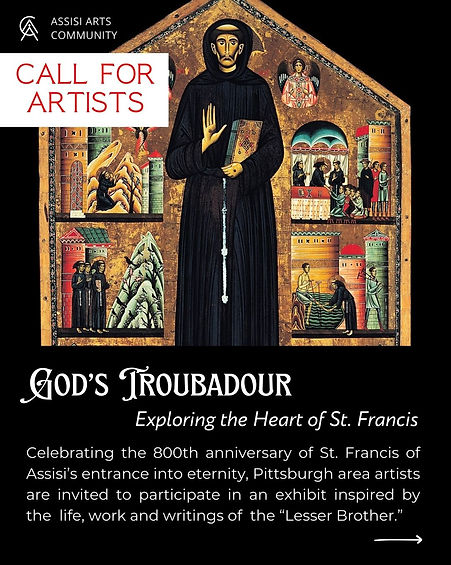
St. Francis and Scenes from his Legend (cropped). Master of the Bardi Altarpiece. 1260s.
CALL FOR POETS & SONGWRITERS

As part of this exhibit, we are expanding our call for artists to a call for songwriters and poets as well. St. Francis was himself a poet and lover of song, composing the Canticle of the Creatures—one of the first great works of Italian literature.
Like past exhibits, we will host a number of accompanying events to explore the theme through various art forms. Some of these events will provide opportunities for artist to share their works. Select artists will be invited to perform their poetry or music at one of these events.
There may also be opportunities to share works, particularly poetry, in either printed materials for the exhibit or via online media.
SUBMISSION DETAILS
Submission deadline: September 18th
Artist notification: TBD
Please note: Generative AI is not permitted in the creative process of submitted work.
Details
-
Up to four submissions per artist
-
Email submissions to AAC@portpgh.com
-
Please include:
-
Submission list: title, artist(s), year.
-
A short artist statement is requested with work, particularly for poems and songs that were not written specifically for this exhibition.
-
Include the text of poems/lyrics and attach a recording/demo of all songs
-
Label music recordings with "Last Name_title"
SUGGESTED THEMES
Throughout history St. Francis has remained one of the most beloved figures of the Christian tradition. Whether it is his reverence for creation, his radical solidarity with the poor and simple dependence on God, or his capacity to see all around him as brother and sister, Francis has inspired generations to more passionately embrace the Gospel life. While he is often reimagined today as a gentle figure preaching to birds or a quiet statue in a garden, Francis was a man of fierce conviction, transformed by a profound encounter with divine love, such that he sought but one thing—to walk perfectly in the footprints of Jesus Christ.
For this exhibit, artists are invited to an exploration of the life and spirituality of St. Francis beyond simple caricatures. Below are seven themes to consider for exhibit submissions. While depictions of scenes from the life of St. Francis are certainly welcome, artists are also invited to take a more abstract approach to these concepts.
A variety of resources are provided for artists to dive deeper into St. Francis as they prepare works for the exhibit. If you have any questions or are looking for additional resources, please reach out to us at aac@portpgh.com.

1. “Il Poverello”
The “little poor man of Assisi,” an early description of Francis, summarizes a central feature of his conversion. Growing up in a wealthy merchant family in medieval Assisi, Francis’ youth was marked by grand visions of fame and fortune as a knight. In his encounter with Christ, this paradigm was upended as Francis sought to possess nothing of his own, such that he could be totally filled by God. Francis was in many ways austere, but it was not a cold austerity, nor was it a rejection of the material world. Rather, Francis’ poverty was a joyful and radical dependence on God’s providence, and recognition that everything is gift. He spoke as a troubadour of his love, Lady Poverty.

2. A Lesser Brother
One of the catalysts in Francis’ conversion was an encounter with a man with leprosy. Up to this point, Francis had a great aversion or fear of the disease and went to great lengths to avoid those with it. But having resolved that he would become a “knight of Christ”, when he encountered the man, Francis dismounted his horse and embraced him. Francis was filled with tremendous joy and along with his early followers, Francis began serving leper communities on the outskirts of Assisi. When taking a name for his community, Francis chose friar minors, or lesser/little brothers. Francis, no longer seeking worldly power, instead sought to be a brother to all. This was illustrated later in his life when amidst the violence of the Fifth Crusade, Francis traveled to Egypt, not to fight, but to bring the Gospel to Sultan al-Malik al-Kamil.

3. Francis and the Cross
The second catalyst in Francis’ conversion occurred in the small chapel of San Damiano. Francis had begun seeking out places of solitude to pray and pour out his heart before the Lord. One day while praying in San Damiano, he heard the voice of Jesus say: “Francis, go and repair my house which, as you see, is all being destroyed.” While Francis initially responded literally by rebuilding San Damiano and other small chapels that had fallen into disrepair, this calling had much bigger implications as Francis and his followers would become a major force of renewal within the Church. From this time also, Francis had a deep devotion and compassion for Christ crucified. The cross was the image of our salvation. And it revealed the humble love of God who emptied Himself, becoming one like us, and giving up His life for us on the cross (cf. 1 Phil. 2:6-11).
4. Canticle of the Creatures
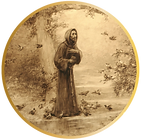
Today, St. Francis is widely known for his love of creation—he preached to birds; he tamed a wolf. This deep kinship with nature was not merely a love for the outdoors. He loved creation precisely because of its connection to the Creator. Creation expresses the goodness of God, and Francis could call the sun and moon brother and sister because of the Incarnation, when God entered the physical world. The sun, the moon, stars and fire all bear the fingerprints of a God who loves us and is with us. This is beautifully articulated in Francis’ Canticle of the Creatures, a poem that is widely considered the first great work of Italian literature. One might be surprised to find at the end of the Canticle of the Creatures, a verse addressing “Sister Bodily Death.” Although death was not part of creation, through Jesus’ death and resurrection, Francis recognized Christ’s victory over death as the key that transformed death into a new birth into eternal life for those faithful to Christ’s calling. Francis added this verse shortly before his passing. Rather than fearing death, he greeted her as sister, with confidence and trust in God.

5. The Body & Blood of Our Lord
Francis was in Rome during the Fourth Lateran Council. A major focus of the council was Eucharistic reform, formally defining the doctrine of transubstantiation and establishing new standards of reverence and solemnity for the Sacrament. This love for the Eucharist resonated with Francis who embraced the message and frequently reiterated it to his followers. For Francis, the Eucharist in a particular way exemplified the humble love of God who continues to make Himself present to us. In a letter to the entire order Francis implored his followers: “Let everyone be struck with fear, let the whole world tremble, and let the heavens exult when Christ, the Son of the living God, is present on the altar in the hands of a priest! O wonderful loftiness and stupendous dignity! O sublime humility! O humble sublimity! The Lord of the universe, God and the Son of God, so humbles Himself that for our salvation He hides Himself under an ordinary piece of bread! Brothers, look at the humility of God, and pour out your hearts before Him! Humble yourselves that you may be exalted by Him! Hold back nothing of yourselves for yourselves, that He Who gives Himself totally to you may receive you totally!” (LetORD 26-30).

6. Nativity & Incarnation
For Francis, the Incarnation, or God entering into our human reality was a defining characteristic of his spirituality. Just as God continues to come to us in the Eucharist, Jesus’ coming, not as a king but as a vulnerable child, illustrated the intimacy of God’s love for us. This self-emptying love of God was the model that Francis strove to imitate in his own embrace of Lady Poverty—he sought to give up everything in loving response to the God who first loved him. And it was God’s entrance into creation that made it possible to speak of the created order as brother and sister. In particular, the event of the nativity was close to Francis’ heart. In 1223, desiring to experience tangibly the humble conditions of Jesus’ birth in a manger, Francis and a young nobleman set up the first recorded living nativity. As villagers came from all around, the brothers sang and Francis joyfully proclaimed the Gospel, filled with love by the image of the humble Christ child, leading many to conversion.

7. Seraphic Love
The Franciscan Order is sometimes referred to as the “Seraphic Order”, and St. Francis as the “Seraphic Father.” This odd title finds its origin in the Hebrew word saraph, “to consume with fire” and its connection with seraphim angels, the angels that stand before God’s throne in constant adoration. Francis was a man who burned with love for Christ. While loving creation, and his brothers, and all of the good of this world, he wanted nothing more than to be consumed totally with love of God. This love found its ultimate expression in an event near the end of his life. At Mount LaVerna, while fasting and meditating upon the Passion of Christ, Francis received a vision of Christ crucified, born on six seraph angel wings. The early biographers share that in this encounter, Francis received the wounds of Christ in his own hands and feet. St Bonaventure recounts that, “with the seraphic ardor of desires, [Francis] was being borne aloft into God; and by compassionate sweetness he was being transformed into Him Who chose to be crucified out of the excess of His love” (LMj 13.2). Francis was so moved by the depth of God’s humble love, that this love was mirrored in his own body.
RESOURCES
RECOMMENDED BOOKS
The Perfect Joy of Saint Francis
An engaging life of in narrative form.
Francis of Assisi: Performing the Gospel Life
Lawrence S. Cunningham
A short and insightful modern biography.
Francis of Assisi: The Life and Afterlife of a Medieval Saint
André Vauchez
A well done (and longer) modern biography.
Saint Francis of Assisi
G.K. Chesterton
A “literary portrait” getting at the heart of St. Francis.
The Life of Saint Francis of Assisi
Saint Bonaventure
An early account and theological reflection on Francis' life.
RECOMMENDED VIDEOS
St. Francis of Assisi: Sign of Contradiction
Fr. Dave Pivonka
A great overview of St. Francis' life. You can watch with a free trial.
The Pivotal Players: St. Francis
Bishop Baron / Word on Fire
Another great overview of St. Francis' life.
FRANCIS' WRITINGS & EARLY BIOS
Create a free account to access the writings of St. Francis of Assisi as well as early biographies, such as Celano, Bonaventure's Major Legend, and more. These can be found in the three volumes of Saint Francis of Assisi: Early Documents.
God's Troubadour
CALL FOR ARTISTS
Fall 2026 Exhibition


2026 marks the 800th anniversary since the passing of Saint Francis into eternal life. This medieval man from Assisi has captured the hearts and imaginations of generations. Whether it is his radical renunciation of wealth and prestige, his love of creation, his service to the least in society, his poetic heart, or his mystical depth, Saint Francis continues to speak to today's world.
In celebration of this anniversary, our fall exhibit and series is an invitation to reflect and explore the heart of this saint. Throughout the year we will be hosting a range of opportunities to learn more about St. Francis, his life and his spirituality. We will be providing a number of prompts and resources to assist artists as they make works for this exhibit.
For this exhibit, we plan to expand the call for artist beyond the visual arts to poetry and music as well. Stay tuned for more information to come soon!
Peace & all good,
The AAC team and Capuchin Friars at The Port

.jpg)
SUGGESTED READING
Spes Non Confundit (Hope does not disappoint)
Christian Hope in the Catechism
Scriptures on Hope
-
Psalm 42 – "Hope in God; I will praise him still"
-
Psalm 130 – "Out of the Depths"
-
Jeremiah 29:10-14 – Trust in the Lord’s providence
-
Romans 5:1-5 – Hope and perseverance in trial
-
Romans 8:18-25 – "the glory to be revealed"
-
Revelation 21:1-5a – "I make all things new"


